
Executive Summary
I was once brought in to replace a CRO the board was convinced was running a broken sales process. A few weeks in, the data showed his sellers were working leads that marketing had badly misqualified. He wasn't the problem. No one had checked before deciding he was.
That's one of the stories behind this article for Boardroom Pulse. Boards bring real discipline to CEO succession: skills matrices, benchmarking reports, and candidate lists they've curated over years. The sales leader rarely gets the same rigor, even though that seat turns over more often and a wrong hire costs the company in missed revenue, staff morale and recruiting fees.
The numbers are rough. CRO tenure now averages 1.8 years, the shortest of any C-suite role, according to SaaStr's analysis of 14,000 executives in Pave's compensation database. Harvard Business Review research found that 62% of companies see revenue growth decline or stay flat in the fiscal year after a CRO change. And every fall, boards decide whether the current leader is right for next year, racing to get anyone new in place before the January sales kickoff.
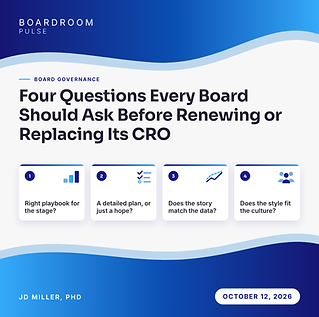
As CRO in Residence at Rothschild & Co.'s Five Arrows, I work on CRO searches for portfolio companies, where a four-to-five-year hold period leaves little room to get this wrong. So the piece lays out four questions.
Does the leader's playbook match the company's stage? A Fortune 100 resume built on dedicated outbound teams, sales engineers on every call and a deal desk says little about whether someone can build those things from nothing. Ask what they personally built versus inherited.
Is there a detailed plan, or just a hope? "Grow 20% next year" isn't a plan until someone models the win rate, deal size and sales cycle it requires, and compares them with last year's performance.
Does the leader's story match their data? Salespeople are great storytellers, but a board doesn't exist to evaluate storytelling. A weekly flash report puts the board in front of the same leading indicators the CRO is watching, long before the quarterly meeting.
Does the operating style fit the culture? Too many evaluators substitute how much they enjoy the CRO's company. That's a likability question. The one that matters is effectiveness.
The boards that get this right don't wait for the fall crunch to ask these questions for the first time. They treat CRO evaluation as a standing governance exercise. It's the idea behind the "What a Board Should Actively Be Evaluating" section of my Turnover Toolkit, and Chapter 12 of The CRO's Guide to Winning in Private Equity, "Interacting With Your Board," covers the same relationship from the CRO's side of the table.